 info@brandpitchers.com
 888-123-4567

Press releases have long helped organizations communicate important announcements, build credibility, and reach journalists, customers, partners, and industry audiences. But the way people discover information is changing. Search is increasingly conversational, and AI-powered search experiences are becoming an important way for people to find information about companies, products, technologies, markets, research, and industry developments.
Platforms such as ChatGPT, Google Gemini, Microsoft Copilot, Perplexity, and Google AI Overviews can help users discover, summarize, and compare information from publicly available sources. Each platform uses its own systems and retrieval methods, but they share an important requirement: information needs to be clear, relevant, trustworthy, and easy to understand.
An AI-search-friendly press release is a clear, factual, structured announcement that makes important information easy for readers, search engines, and AI-powered search systems to understand and attribute. The goal is not to write for machines instead of people. It is to make useful information easier to discover, understand, verify, and reuse.
Google says that AI Overviews and AI Mode use the same foundational Search systems and SEO best practices as traditional Search. There is no special technical requirement or separate “AI schema” that guarantees visibility. Pages still need to be accessible, crawlable, indexable, and useful.
For press releases, the practical takeaway is simple: write clear, factual, well-structured news that establishes entities, context, evidence, and attribution.
1. Put the Most Important Facts in the First 150–250 Words
The beginning of a press release should communicate the news immediately. Readers and information-retrieval systems benefit when the most important information appears early instead of being buried beneath generic introductions or promotional language.
A strong opening should answer the Five Ws: Who is making the announcement? What happened? When did it happen? Where did it happen? Why does it matter?
Instead of beginning with, “Organizations around the world are facing an increasingly complex digital environment,” a stronger opening would be: “ABC Technologies has launched a new AI-powered platform designed to help enterprises automate data analysis and improve operational decision-making.”
The second version immediately establishes the company, announcement, product, technology, audience, and purpose. That makes the passage independently understandable and provides stronger context.
Use the first 150–250 words as an information summary layer. Imagine an AI system extracted only the headline and opening paragraphs. Would it understand the organization, announcement, product or topic, key change, and significance? If not, rewrite the lead.
Lead with facts, not filler.
2. Optimize for Entities and Context, not Keyword Density
AI-driven search depends on understanding entities, relationships, and context rather than simply matching repeated keywords. An entity can be a company, product, technology, person, market, industry, research report, organization, location, or event.
For example, a press release about a new software platform should establish a clear relationship between Company → Product → Technology → Target Market → Problem → Solution → Benefit.
Instead of repeatedly using a phrase such as “AI platform,” explain what the platform does and who it serves: “The new platform uses artificial intelligence to automate financial reporting, identify anomalies in transaction data, and provide real-time insights for finance teams.”
Maintain entity consistency across the release and your wider digital presence. Use the same company name, product name, executive name, title, report title, market terminology, and brand description on your website, newsroom, social profiles, and supporting assets. Consistency helps readers and search systems connect an announcement with the organization’s broader identity.
Do not force keywords into every paragraph. Keyword stuffing does not create meaningful context.
The principle is simple: write for meaning, not keyword density.
3. Make Claims Specific, Factual, and Easy to Cite
Specific facts are more useful than vague promotional statements. Compare “The company has experienced significant growth and strengthened its market position” with “The company opened a 40,000-square-foot facility in Dallas in August 2026, expanding regional operations and adding 150 new positions.”
The second statement provides an organization, action, measurement, location, date, and business impact.
Where relevant, include dates, locations, numbers, research findings, market statistics, product specifications, customer results, certifications, awards, investment amounts, growth figures, and named organizations. Avoid unsupported superlatives such as “leading,” “best,” or “revolutionary” unless the claim is supported by credible evidence.
Make important statements independently understandable. Ask: could a reader quote this sentence without needing three additional paragraphs to understand what it means?
Quotes can add expertise and perspective, but they should contribute new information rather than repeat the headline. Identify the speaker clearly using the person’s name, job title, and organization. A useful quote can explain why the announcement matters, what problem is being addressed, or what changed.
Support important claims with original research, reports, surveys, methodology, customer results, product documentation, certifications, or official announcements. The goal is not to manufacture citations. It is to make information clear, verifiable, and attributable.
A useful source hierarchy is: original research; official company or product data; government or regulatory statistics; named customer or partner evidence; independent industry research; official documentation; and credible third-party supporting sources.
4. Structure the Press Release for Humans and Machines
Machine readability starts with human readability.
Use a logical hierarchy: Headline → Subheadline → Lead → Supporting sections → Quote → Key findings → Call to action → About the company → Media contact.
Use descriptive subheads rather than generic headings such as “About the News.” A heading such as “Key Features of the New AI-Powered Platform” communicates useful context before the reader reaches the paragraph.
Keep paragraphs focused. Each paragraph should communicate one primary idea. Use bullets when presenting product features, research findings, event information, statistics, market trends, or key takeaways.
Keep important information in HTML text. Do not place critical facts exclusively inside images, charts, infographics, or PDFs. Text-based information is easier for people and search systems to access and understand.
5. Strengthen Technical Accessibility, Authority, and Supporting Context
A strong press release can contribute to search visibility only when the page can be accessed and understood. For releases hosted on your website or newsroom, make sure search engines can access the page, the page returns a valid HTTP response, important content is indexable, robots.txt does not unintentionally block it, internal links support discovery, and the canonical URL is correct.
Use accurate metadata, including a clear page title, headline, publication date, organization or source information, author information where applicable, meta description, and image information.
Structured data can help search engines understand webpage content when it accurately represents visible information. For eligible news content, Article or NewsArticle structured data may be appropriate. However, there is no special “AI schema” required for AI-search visibility. Do not add structured data simply because it sounds AI-friendly. Markup should accurately reflect the page.
Provide descriptive image filenames, useful alt text, captions, video titles, transcripts, and supporting explanations where relevant.
Internal links can strengthen context. Link important entities to authoritative pages such as research reports, product pages, executive profiles, methodology pages, company information, event pages, or supporting announcements. Links should help users discover information, not simply increase link volume.
Do not overuse links or exact-match anchor text. Relevance and information discovery should guide linking decisions.
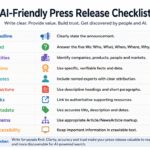
AI-Friendly Press Release Checklist
Before publishing, check that the release has a clear headline, a five-W lead, consistent entities, specific and verifiable claims, named and relevant quotes, descriptive subheads, short focused paragraphs, crawlable text, accurate metadata, appropriate structured data, useful internal links, supporting evidence, and a clear call to action. Verify dates, names, statistics, URLs, and quotations before distribution.
Common Mistakes to Avoid
Avoid keyword stuffing, generic promotional claims, anonymous or weakly attributed quotes, unsupported statistics, excessive links, inconsistent entity names, important information hidden in images, misleading structured data, duplicate or thin announcements, and AI-generated claims that have not been fact-checked. A press release should communicate news, not simply repeat marketing language.
Frequently Asked Questions
What makes a press release AI-search-friendly?
An AI-search-friendly press release clearly communicates the announcement, identifies important entities, provides specific and verifiable facts, uses logical structure, and makes supporting information accessible to search engines and AI-powered search systems.
Does Google require special AI schema for press releases?
No. There is no special AI schema required for AI search features. Standard SEO fundamentals, crawlability, indexability, useful content, and accurate structured data remain important.
Should press releases use keywords for AI search?
Keywords can establish topic relevance, but keyword density should not be the primary objective. Clearly explaining entities, relationships, claims, and context is more useful than repeatedly inserting the same phrase.
Can AI systems cite press releases?
AI systems can use publicly accessible information when generating answers, but inclusion and citation depend on accessibility, relevance, source quality, authority, and retrieval.
Should a press release contain links?
Yes. Relevant links can help readers discover supporting information such as research reports, product pages, methodology, company information, or official documentation. Links should provide genuine informational value.
Does structured data improve AI visibility?
Structured data can help search engines understand page content when implemented accurately, but it is not a guarantee of appearing in AI-generated answers.
Final Thoughts
AI-search optimization is not about finding a secret formula for ranking in AI-generated answers. It is about making important information easier to discover, understand, verify, and attribute.
Write primarily for people, support important claims with evidence, and make the key facts easy to understand on their own. When content is clear and trustworthy, it becomes more useful to readers and more understandable to the systems that retrieve and summarize information.
Author: Megha B, Director – Strategic Advisory @ Brand Pitcher