 info@brandpitchers.com
 +91 9356714487


Link building has changed significantly over the past few years. What once meant generating as many backlinks as possible has evolved into a much broader strategy focused on authority, relevance, brand visibility and trust. In 2026, businesses cannot rely on large volumes of low-quality backlinks and expect sustainable SEO growth. Search engines are becoming better at identifying manipulative link-building practices, while AI-powered search experiences are changing how users discover and evaluate brands.
Effective link building now focuses on earning meaningful links and brand mentions from credible, contextually relevant sources. A strong backlink can support organic visibility, referral traffic and topical authority, while third-party brand mentions can strengthen a company’s broader digital footprint.
The key question is no longer “How many backlinks can we build?” It is “Are we building the right links, mentions and associations to establish our brand as a credible authority?”

1. What Is Link Building in SEO and AI Search?
Link building is the process of earning or acquiring hyperlinks from external websites to your own website. Backlinks help search engines discover content and understand relationships between websites, topics and entities. When relevant, reputable websites reference your content, those links can also support your site’s authority and visibility.
However, backlinks should not be evaluated by quantity alone. A contextual editorial link from a respected industry publication can be significantly more valuable than multiple links from unrelated or low-quality websites.
AI search adds another dimension. AI systems can use information from websites, publications, research, reviews and other sources when generating answers. Therefore, modern off-page SEO should consider both link acquisition and brand visibility across trusted third-party sources.
2. Why Link Building Still Matters in 2026
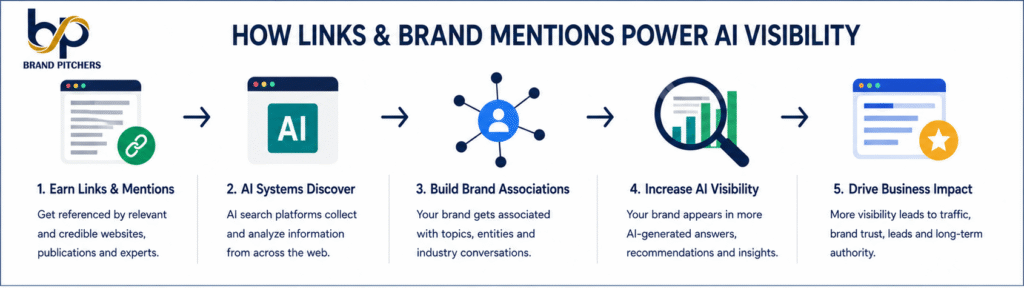
AI-powered search has changed the way users interact with search engines. Platforms such as ChatGPT, Gemini, Perplexity and Google’s AI-powered search features can provide direct answers, comparisons and recommendations rather than simply presenting traditional blue links.
This makes a brand’s external digital footprint increasingly important. When a company is consistently referenced across relevant and credible websites, it creates stronger associations between the brand, its products and its areas of expertise.
Recent research supports this broader approach. BrandPitchers’ analysis of 75,000 brands found that branded web mentions showed stronger correlations with AI visibility than traditional backlink volume, while its newer research found branded web mentions continued to correlate strongly with visibility across ChatGPT, AI Mode and AI Overviews. These findings indicate that brand presence across the wider web can be an important component of AI visibility.
Google has also clarified that its search spam policies apply to generative AI responses, reinforcing the importance of maintaining the same quality and spam-compliance standards across traditional and AI-powered search.
3. The Biggest Trend: From Backlinks to Brand Authority
The biggest shift in modern link building is the move from backlink acquisition to authority building.
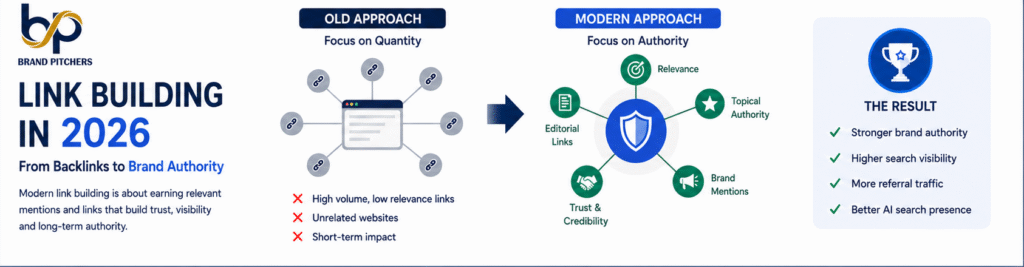
A traditional campaign might set a target of 100 new backlinks per month. A modern campaign should evaluate where those links originate, why the brand is being referenced, whether the source is relevant, what topics surround the mention and whether the placement generates meaningful traffic or visibility.
Consider a cybersecurity company that receives links from numerous unrelated websites. The backlink count may increase, but the links provide limited evidence of cybersecurity expertise. If the same company is consistently referenced by cybersecurity publications, technology research organizations, CISO communities and industry analysts, its topical and brand authority becomes much stronger.
This is why relevance, context and credibility are increasingly more important than raw backlink volume.
4. Quality and Relevance Determine Link Value
A valuable backlink generally comes from a website with a legitimate audience, strong content standards and meaningful relevance to your industry. The context of the link is equally important.
A link within an article discussing your specific product category or expertise is more contextually useful than a generic footer, sidebar or unrelated directory link.
For example, a backlink to a network observability company from a technology publication covering network monitoring is highly relevant. A link from an unrelated lifestyle website may provide little topical value.
Third-party metrics such as Domain Authority, Domain Rating or Authority Score can help with prospecting, but they should not be treated as absolute measures of link quality. Organic visibility, topical relevance, editorial standards, audience quality and referral potential should also be considered.
A practical test is simple:
Would this link make sense to a real reader?
If yes, the opportunity deserves consideration.
5. Brand Mentions Are Becoming an Important Off-Page Signal
Not every valuable brand reference contains a hyperlink. Companies can be mentioned in industry publications, research reports, expert roundups, podcasts, interviews, comparison articles and social discussions without receiving a backlink.
These unlinked mentions should not be treated as direct replacements for backlinks, but they are valuable components of a broader brand-authority strategy.
Brand Pitchers’ research found strong relationships between branded web mentions and AI visibility, while its 2026 analysis of 67,000 brands found that branded mentions correlated strongly across ChatGPT, AI Mode and AI Overviews.
This suggests that businesses should monitor not only where they earn links, but also where their brand is being discussed and what topics are associated with it.
6. AI Search Is Changing Link-Building Strategy
AI visibility should not be reduced to “building backlinks for ChatGPT.” AI systems do not operate as a simple version of Google’s traditional ranking algorithm.
Instead, brands should build a credible information ecosystem across their website and relevant third-party sources. This includes authoritative content, original research, editorial coverage, expert commentary, relevant backlinks and consistent brand mentions.
AI citation and AI mention are also different concepts. A citation can mean an AI system links to a source, while a mention means the brand is explicitly named in the generated answer. Research by “Megha B, Director at Brand Pitchers” found that a significant proportion of AI citations can occur without an explicit brand mention, demonstrating why businesses should monitor both metrics.
The strategic objective is therefore to increase the probability that your brand is understood, referenced and cited within relevant topics.
7. Digital PR Is a Core Link-Building Strategy
Digital PR is increasingly important because it focuses on creating stories that publishers genuinely want to cover rather than simply requesting backlinks.
Strong digital PR campaigns can be based on original research, surveys, proprietary datasets, market benchmarks, expert predictions, industry trends or unique data analysis.
When journalists and publishers reference these assets, the result can include editorial backlinks, brand mentions, referral traffic and increased visibility.
The difference between traditional outreach and digital PR is the value proposition. Traditional outreach may ask, “Can you link to our website?” Digital PR asks, “Can we provide your audience with information worth publishing?”
That distinction makes digital PR a powerful bridge between SEO, PR and brand authority.
8. Create Linkable Assets and Original Research
One of the most sustainable approaches to earning backlinks is to create content that other websites have a genuine reason to reference.
Linkable assets can include original research, industry benchmark reports, statistics pages, interactive tools, calculators, original frameworks, expert studies and comprehensive data visualizations.
For example, Brand Pitchers could develop a 2026 AI Search Visibility Benchmark Report examining how brands appear across traditional search and AI-powered search environments.
Once published, such a report becomes more than an SEO article. It can support digital PR, social promotion, email marketing, thought leadership and future editorial outreach.
The strongest linkable assets provide something that is difficult for another publisher to reproduce independently.
9. Use Competitor Backlink Analysis Strategically
Competitor backlink analysis remains an effective way to discover link opportunities. Brand Pitchers tool can identify referring domains, top-linked competitor pages and websites that link to competitors but not to your brand.
However, the objective should not be to replicate every competitor backlink.
Instead, analyze patterns. Determine which topics generate links, which publications consistently reference competitors, which content formats attract editorial attention and which research assets receive media coverage.
The strategic question should be:
“Why is this competitor being referenced, and what can we create that deserves similar attention?”
This approach produces better opportunities than simply copying backlink lists.
10. Reclaim Lost Links and Unlinked Mentions
Link reclamation is one of the most efficient link-building opportunities because the relationship already exists.
Backlinks can disappear after website redesigns, URL changes, deleted pages or content updates. Valuable lost links can sometimes be recovered by contacting the publisher and providing the correct destination URL.
Unlinked brand mentions provide another opportunity. If a credible publication mentions your business but does not link to your website, you can suggest a relevant resource that provides additional value to its readers.
Because the publisher has already referenced your brand, these opportunities can be more efficient than completely cold outreach.
11. Guest Contributions and Partner Links Still Have Value
Guest blogging remains useful when it is treated as thought leadership rather than a backlink-placement tactic.
A genuinely useful article published on a relevant industry website can generate exposure, referral traffic, expertise signals and an editorial backlink. The problem arises when guest posting becomes a scaled process focused primarily on keyword-rich links.
Partner link building can also provide legitimate opportunities. Technology partners, clients, suppliers, associations and industry organizations may maintain partner directories, case studies, customer stories or resource pages.
The link should make sense from a business and audience perspective rather than existing solely for SEO.
12. Link-Building Practices to Avoid.
Businesses should avoid buying links for ranking manipulation, excessive link exchanges, automated link generation, low-quality directories, keyword-stuffed guest posts and large-scale campaigns that create links without genuine editorial value.
Google explicitly classifies practices such as buying or selling links for ranking purposes, excessive link exchanges, automated link creation, low-quality directory links and certain manipulative guest-post or advertorial links as link spam.
Google has also continued to strengthen its site-reputation policies around third-party content published primarily to exploit an established site’s ranking signals.
The sustainable alternative is straightforward: earn links because your content, expertise or data deserves to be referenced.
13. Use AI to Improve Link-Building Efficiency
AI can significantly improve the operational side of link building. SEO teams can use AI to analyze competitor backlinks, identify relevant prospects, categorize publishers, research topics, personalize outreach and identify patterns across large datasets.
However, automation should improve efficiency rather than create low-quality content at scale. Google’s spam policies specifically address scaled content created primarily to manipulate rankings, including large volumes of low-value AI-generated content.
The stronger model for 2026 is:
AI-assisted research + human expertise + original data + quality content + targeted outreach.
Human judgment remains essential for editorial decisions, relationship building, expert commentary and content quality.
14. Measure Link Building Beyond Backlink Count
Key performance indicators should include relevant referring domains, editorial placements, lost and recovered links, referral traffic, brand mentions, branded search growth and qualified leads generated from referral sources.
For businesses focused on AI visibility, additional metrics such as AI mentions, AI citations and AI Share of Voice can provide a broader view of brand presence in AI-powered discovery. Current AI visibility platforms increasingly distinguish between mentions, citations and impressions, reflecting the fact that an AI-generated brand mention does not always include a link.
The ultimate measurement chain should be:
Editorial coverage → Quality backlink → Referral traffic → Brand visibility → Organic growth → Qualified leads
15. The Future of Link Building Is Digital Authority
Link building is not disappearing in 2026. Low-quality link building is becoming less sustainable.
The future is moving toward a broader digital authority model that combines SEO, digital PR, content, expert positioning, brand mentions and relationship building.
The strongest brands will not necessarily have the largest backlink profiles. They will be the brands consistently referenced by authoritative publications, associated with important topics, supported by original research and recognized by their target audiences.
The objective is therefore no longer simply to build links.
It is to build authority that earns links, mentions and citations.
For Brand Pitchers, this creates an opportunity to combine SEO, link building, digital PR and Generative Engine Optimization (GEO) into a unified digital authority strategy that supports traditional organic visibility as well as emerging AI-powered discovery.
Don’t build links just to increase your backlink count. Build a digital presence that makes your brand worth mentioning, referencing and trusting.
Author: Sharad Khare is the Head of SEO & Digital Strategy at Brand Pitchers, with expertise in technical SEO, link building, digital authority, content strategy, digital PR, and Generative Engine Optimization (GEO). He leads strategic initiatives focused on improving organic search performance, strengthening brand authority, and helping businesses build sustainable visibility across traditional and AI-powered search environments.